Designing
for Trust
How a multi-method foundational study reshaped caregiver profiles into Profile 2.0, and turned trust from anecdote into measurable business outcomes.
Researcher
Mixed
n = 50
Engineering, ELT
+ new standard
Moving beyond anecdotes.
Caregiver profiles had been unified in a prior project, but we had a significant knowledge gap: we didn't deeply understand what builds trust between families (Seekers) and Caregivers. With a company-wide rebrand on the horizon and a directive to ship "Profile 2.0," my task was to move beyond anecdotal feedback.
I needed concrete, actionable evidence to define the core problems with the current profiles, and prove that a research-driven redesign was a critical business opportunity. The investigation was guided by two core hypotheses:
Caregivers feel the burden of trust is a one-way street, and need more from Seeker profiles to feel safe.
Seekers are willing to share more information, if it helps them find better caregivers faster.
Foundational & competitive insights
- Consumer Insights survey, n = 1,750 caregivers. Detailed profiles, identity verification, and reviews surfaced as the three foundational pillars of trust.
- Comparative analysis, Rover, UrbanSitter, Airbnb, LinkedIn. Mapped table-stakes trust signals across direct and adjacent platforms.
Generative user research
- Generative survey, 50 participants (25 Seekers + 25 Caregivers). Moved beyond high-level trends into the specific motivations, needs, and pain points users experience creating and viewing a profile.
- Goal, surface the human "why" the quant phase couldn't reach, segmented by side of the marketplace.
Three findings,
one strategy.
Synthesizing the streams revealed three findings that shaped the entire redesign, each one a strategic lever, not a usability bug.
Trust is a two-way street.
The privacy paradox.
The profile photo gap.
Of Seeker profiles
had a photo.
An immediate barrier to human connection at the top of the funnel. 84.8% of Seekers asked Caregivers to trust them sight unseen, while expecting full profiles in return.
From insight to alignment.
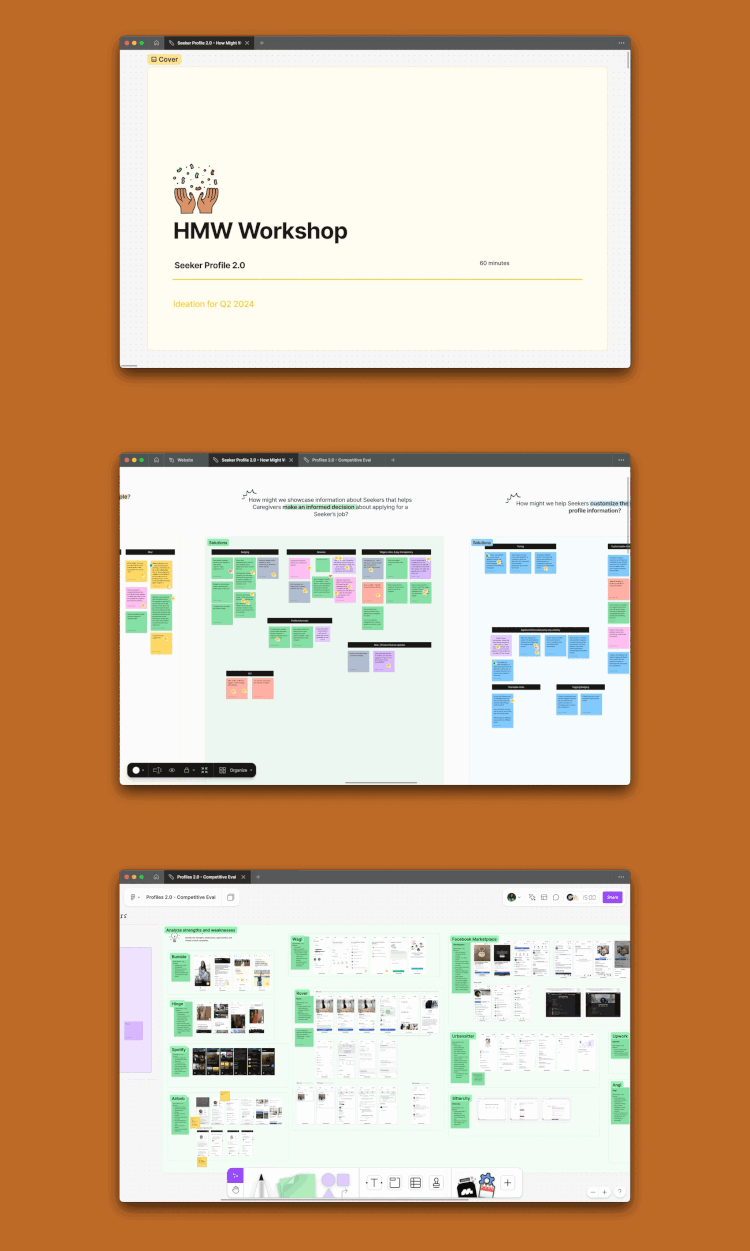
An insight is only valuable if it's understood and acted upon. To bring the research to life, I facilitated two workshops with 35 stakeholders across the company. By grounding the conversation in direct user quotes and compelling data, I built shared empathy across product, design, content, and engineering.
We used "How Might We" activities to collaboratively translate findings into clear opportunity areas. My role continued through design: when technical constraints arose, I partnered with the design team to find creative ways to use existing data to meet the user needs the research had identified.
HMW Workshop, Seeker Profile 2.0.
Two workshops · 35 stakeholders from product, design, content, and engineering. Grounded in direct user quotes from the foundational study and structured around “How Might We” framing.
Output: a shared opportunity map that became the spec for Profile 2.0.
Research that moved
three business metrics.
The final design, guided at every step by this foundational research, had a measurable impact. The redesigned caregiver profiles delivered:
Basic → Premium
Lift in upgrade rate after the profile redesign shipped.
Match completion
Uplift in fulfillment metrics, the rate at which Seeker requests resulted in a successful hire.
Submission rate
Relative uplift in review submissions, reinforcing the social-proof flywheel that drives marketplace trust.
A new standard for the team.
Beyond the numbers, this research-driven process became the new standard for product and design at the company. It demonstrated, in dollars and metrics, how grounding major initiatives in evidence-based user research leads directly to better experiences and stronger business outcomes.
Profile 2.0 stopped being a UI refresh and became a trust strategy.
Marketplace trust is universal.
The asymmetric-trust framework I used here, Caregiver vs. Seeker, maps directly to any two-sided platform: buyer/seller marketplaces, B2B vendor relationships, AI assistant/user dynamics, peer-to-peer networks.
The methodology of quantifying a vague problem (15.2%) to mobilize design and engineering around it is the same play research leaders run inside every product org.